Sunday, December 4, 2011

A true test of the new Sigma 120-300mm f2.8 lens

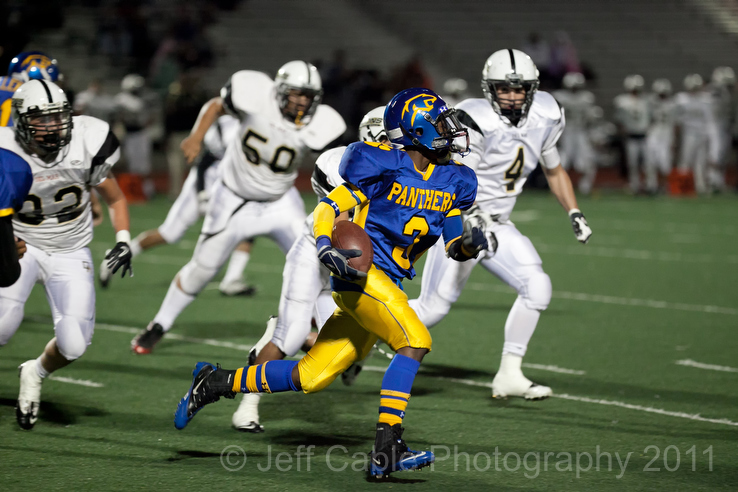
If you have been following my blog for the last month or two, you might have seen the entry about me shooting a night football game. During that game, I used my Canon 5D Mark II with the Canon 100-400mm variable aperture lens (which is variable aperture). I was really looking forward to capturing images in that lighting, but not thrilled that I had to go to ISO 6400 to get a shutter speed fast enough to capture the action. So...I figured that it was time to bring in the big guns. I borrowed the new Sigma 120-300mm f2.8 lens (more to capture images of a bar mitzvah inside a dark temple) and figured that it would be great to test it out at another night game. I had some questions in my head as I headed towards the field. Firstly, could I shoot at ISO 1600 with the fast lens? Secondly, how fast would this lens focus? Lastly, how sharp would it be?


I set up the camera and lens on my Gitzo monopod, since the lens is about 6.5 pounds and not something I wanted to hand-hold for a couple of hours. And then it was time to answer question number one: What ISO could I shoot at? I tried shooting at ISO 1600 but, even at f2.8, determined that ISO 3200 would be a safer bet to buy me a little faster shutter speed. Having shot at this high ISO many times before, I was much more comfortable and happier at 3200 than pushing the camera any higher.


Shooting this lens wide open at f2.8 gave me another advantage over the Canon 100-400mm lens. Not only could I shoot at a lower and cleaner ISO, I could also further separate my subject from background and the other players on the field. This is very apparent in the photo above, where the running back is perfectly in focus, while the wide receiver is soft.


Lastly, there was the question of focusing speed. When photographing sports, I usually set my camera to servo focus and use the center focus exclusively, and this is what I did on this evening. The lens tracked very well, with almost no lag or perceivable noise.



I have been shooting with the Canon 100-400 so much that I was used to the push-pull zoom. It did take me a little while to get used to the rolling zoom of the Sigma lens, but did not hinder my shooting at all. The OS image stabilization worked very well, even with the lens mounted on my monopod. 

In a recent blog post, I did show a bunch of images which I shot at the San Jose Sharks game, using this same lens. But, an NHL game is lit pretty well. How would this lens perform inside a roller rink with really nasty lighting? It was time to try that too.


In the two images above, you will notice that even at ISO 3200 and an aperture of f2.8, there is still motion in final images. That just shows you how tough this shooting environment is. There is no way that I could have shot these images with a variable aperture lens. I was lucky to get 1/250 sec, which is really needed to freeze any kind of action.


The two shots above are photos of my son taking a slap shot. I love watching my son play hockey, and it is also nice to be able to supply images to his teammates and staff. I will tell you that walking into the rink with the big Sigma lens definitely turned some heads. With 23 elements of glass, the long black tube, and a whopping 105mm filter size, this is no small lens that can be used in the background. When you shoot with this thing, people know you are serious.


It was so nice to be able to freeze the action. The combination of shooting at f2.8, lower ISO levels AND having the reach of 300mm was awesome. There were times when 300mm was almost too much lens for this type of sport, but other times when I was loving the really tight shots.

I was very impressed with the solid build of the lens and the quality of the images, so much so, that I dropped the big money and purchased this beast to add to my collection. I guess that says it all.


Thursday, December 1, 2011

Macro photography: A really close look at our front and back yard

Before the cold air and blustery winds made their entrance, I decided to go outside and shoot some macro shots of the yard. When I teach photography, I am often asked about shooting locations. I tell people that you don't need an exotic location to get nice photos, just go outside and take a close look at your surroundings. With that in mind, I stepped outside into my back yard and focused on a small group of flowers.


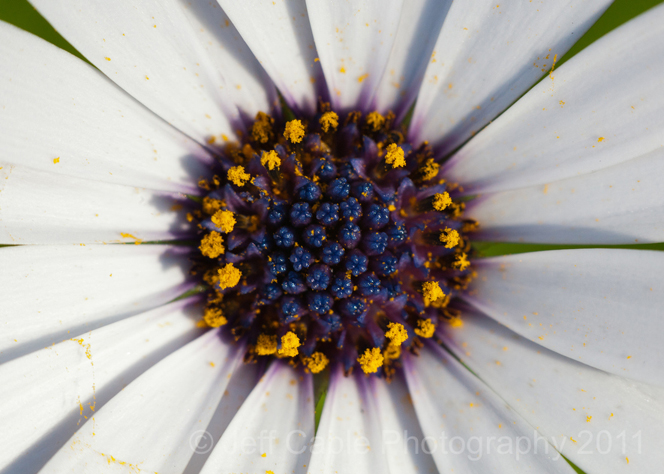
I started by shooting this one flower. I liked the way that the white petals and blue and yellow inside colors worked against the green leaves in the background.


Then, using my Sigma 150mm macro lens and an extension tube, I moved in closer. My goal was to bring the details of the flower into view. How many people stop to look this close at a flower? I like the symmetry of the flower, but was also interested in showing the pollen spread across the petals. After looking even closer at the pollen, I noticed that much of it was not on the petals, but was suspended above the flower on very faint spider webs.


And then, after spending a little more time looking closely at the flower, I noticed that the owner of those webs was hanging out on the backside of the flower. I waited a while and the spider decided to come up for an appearance.


My new friend, and neighbor, hanging out on his flower. (Photographer's note: Don't be impatient when photographing nature. I once took a snorkeling class at the Great Barrier Reef in Australia, and the instructor explained how you would see so much more if you stopped in one spot and REALLY looked around. He explained that we were not in the water for exercise, but to see the wonders around us. I took his advice and swam slowly, often stopping for long periods of time, and saw things that I would normally have missed. The same is true when it comes to macro photography. Don't just look at the obvious! Then, zoom in, capture the details, and show your friends a world that they are missing. )


After shooting the images in the back yard, and being intrigued by the little visitors to our yard, I then went to my front yard to capture the Brown Skipper Butterflys who were busy.


As I mentioned, the greatest thing about macro photography is that we see things that normally are not seen. I shot hundreds of images of these butterflys (since they move fast and macro photography requires a very steady hand and precise focusing). Looking through my images I was able to see just how the insects were collecting their nectar, using their proboscis. The proboscis is really cool and rolls up like a party noisemaker. This then can be extended into the flower for easy extraction of the nectar. I have seen thousands of butterflys in my life, but never really taken the time to see them this way.


I like these last two images, because not only am I capturing the Brown Skipper while collecting their nectar, but I am capturing them as they are watching me. I wonder what they were thinking as they stared into my lens. Hmmmm...maybe they learned something about me. :)


Friday, November 25, 2011

Photographing the San Jose Sharks vs. Chicago Blackhawks

It has been a while since I have photographed a San Jose Sharks game. With my current work load, travel schedule, family time, and other things, it has been hard to fit this in. But, on Wednesday night, the day before Thanksgiving, I got headed over to the HP Pavilion to capture the Sharks vs. the Blackhawks. And this time, I did not shoot from a glass position, but instead used the new Sigma 120-300mm 2.8 lens from a higher position. I wanted to see how this big lens, being shot wide open, would perform in this environment. I usually shoot the Sharks games at ISO 3200 with the Canon 1D Mark IV, but with this lens, I was able to shoot at ISO 800 with an aperture of f2.8 and still get 1/1000 sec. Awesome!!!


I started from the far side of the arena to capture images of the players coming out of the Sharks head. I have photographed this before, using the strobes in the rafters, but wanted to shoot this without any additional light, to capture just the lights from the Sharks head.


Then it was game time, and Antti Niemi, the Sharks goalie, was awesome from the start. (Photographer's note: When photographing hockey, it really helps to get the puck in the shot. Not always, but for the action around the net, it adds urgency and helps the viewer understand what is happening at that moment.)


Logan Couture gets the puck on his stick to keep it out of the Blackhawks players reach.
 

I love the intensity on the face of Jonathan Toews as he tries to make an offensive move from behind the net. 

Douglas Murray is an absolute tank on the ice, and not easy to take down. Here is a shot of him absorbing a check and protecting the puck.


I usually do not position myself behind the protective nets, but happened to be in this spot when this action occurred. Another amazing save by Niemi.


Chicago's goalie, Corey Crawford, peaking out from behind Joe Pavelski.


This is not one of the best photos from the game, but it happened to be the game winning (and only) goal of the night.


The one and only celebration of the evening, but all that it took to win the game 1 to 0.


Another photo from behind the protective netting, but I love the expression on Joe Pavelski's face as he absorbs a shot in front of the net.


Jumbo Joe Thornton cycling the puck in the offensive zone.


As I went through the 1400 images from the game, this one caught my eye. I liked the way that all three player's sticks were going for the puck. Very geometric! :)


Andrew Murray deflects the puck just wide of the net. Oh, so close to a goal!


Here Michal Handzus shields the goalie and the Sharks almost get a goal. The puck looks like it is going in the net, but it went wide to the left of the pipes.


Then the clock counted down to zero and the Sharks came out with another win.


I was in the locker room visiting with my friends from the team who I have not seen in a while. As we were talking, I was watching all the reporters interviewing Antti Niemi, and decided to shoot a couple of images of this. He had an amazing night with his shut out vistory, and was the number one star of the game.

Friday, November 18, 2011

Senior portraits of Claire - who is not quite a senior yet

It was the middle of October and the weather was really nice here in the San Francisco Bay Area. I had been talking to a family friend of ours for weeks, trying to coordinate a time to shoot images of her beautiful daughter, Claire. Finally we had a day when I was available, they were available, and the weather was cooperating. Time to shoot!


We drove to a couple of different locations to find good light and nice surroundings. I wanted colors in the background that would compliment Claire's skin tone and outfit. As you can see, Claire has great eyes, so I made sure to highlight them in these images. For the above shot, I used an on-camera flash stopped down a full stop to add a touch of light to Claire's face and get some catch light in her eyes. For the image below, I turned off the flash and relied on a silver/gold reflector (thanks to my wife who was holding that) to add light to the right side of her face.


It is always fun to find new perspectives when shooting portraits. For this shot, I climbed down into a dry riverbed and had Claire stand up above on a foot bridge. (Photographer's note: Whenever I shoot portraits, I do my best to make sure that there are no distracting "objects" in the background. In this case, I moved my position to make sure that there was mostly trees behind her head, so that her blonde hair would stand out from the background.)


Usually, when I shoot portraits, I look for a shaded area with a nice background.  This spot next to a tree was perfect. The canopy of this tree and surrounding trees gave me a nice shaded spot and I had some nice greenery behind Claire, so that she would pop out from the background. I added a hint of fill flash once again and really liked the results. (Photographer's note: When posing a subject, the first thing that I do is, I ask them how they would lean against this tree, in this case, if I were not there taking their picture. This helps me get my subject to look the most relaxed and natural. After they do that, I might ask them to change a couple of things, but try to keep them close to their original pose. Why am I doing that? I want them to be themselves. I really do not want hundreds of pictures of people doing the "standard poses". That is not my style.)


After shooting a bunch of portraits, we decided to hit the nearby railroad tracks (which are rarely ever used) to shoot some final shots. If you have been reading my blog for a while, you know that I have photographed my kids and others on the tracks before. But this time I wanted to do some different poses. I asked Claire to go further down the tracks and walk back to me. While she was doing that, I fired off a bunch of images as she balanced herself and walked towards me. She loves being barefoot, and I think this added to the image.


This was one of the last shots that we took that day, and one of my favorites. Claire looks really relaxed in this pose and I love the way that the train tracks curve in and out of the shot. The tracks work as an element to draw your eye right to Claire.

We had a lot of fun shooting these, and I am sure that we will be doing more photos in the future.