Tuesday, May 3, 2016

The new Canon 1DX Mark II - Testing memory cards and workflow on this new top-of-the-line Canon camera

It is possible that you have read other reviews of the upcoming Canon 1DX Mark II camera. I know I have. But most of the reviews talk about the features and feel of the camera.


As I prepare for the Summer Olympics in Rio, I am more interested in the true usability of the camera and the workflow advantages using the new CFast memory cards.

Canon was nice enough to get me a prerelease version of the upcoming Canon 1DX Mark II so that I could try it for myself and determine the best workflow for my upcoming crazy fast deadlines in Rio.

With my many years at Lexar, I guess I learned more about memory cards and readers than most people would ever want to know. But this gives me a unique understanding of the technology and how the cards perform both in camera and in readers. And, like most of my other camera tests, I do not focus on statistics and charts, instead I am more concerned with how this new camera works in the hands of a working photographer.

When I photographed my first Olympic Games, I had a 12 hour deadline to get images back to the US, but now that 12 hour deadline has decreased to mere minutes. For this reason, workflow is absolutely key for me. So, with this in mind, I set out to test CFast and CF cards in the Canon 1DX Mark II to determine the best possible scenario for me at the upcoming Summer Olympics in Rio De Janeiro.


When first getting the camera, I started by testing it with different memory cards. Here are the results of my tests:

SHOOTING ONLY RAW FILES

For this test, I was using the new Lexar Professional 3500x CFast card and a Lexar Professional 1066x CompactFlash card.

CFast only RAW test

I started by testing the Canon 1DX Mark II with just a CFast card in the second slot. Since I rarely ever shoot in JPEG mode, I skipped that step and went straight to the more memory intensive RAW setting.

I set the camera to it's fastest burst mode and fired off more than 800 full RAW photos before the camera slowed down. and even then, it was a slight hiccup while still firing off rapid bursts. Honestly, my finger got tired doing this test. This is a crazy amount of shots and is it not very likely that I would ever want to shoot this many shots in succession. But it is a testament to the technology that this could be achieved.

CFast and CompactFlash RAW test

I then added a Lexar 1066x Professional CompactFlash card and set the camera to record full RAW images to both cards. To me this is the most important test, because when shooting important jobs (regardless of whether it is a mitzvah, wedding or the Olympics), I like recording to two cards. Even though I have never lost an image, I do this to make darned sure that I get my photos. It is good peace of mind. Staying in burst mode, I hit the shutter release and fired off 81 full RAW photos before the buffer filled and the camera slowed down. The reason for this performance degradation is, when writing the images to the two cards, the camera has to default to the slowest card. In this case, the 1066x CF card was holding back the 3500x CFast card from it's full potential. So...then comes the burning question. Do I write to two cards at the Olympics with a more limited buffer clearing? And the answer is "yes". It is rare that I would ever shoot more than 80 images in one sequence, and as I already mentioned, I want to know that my photos are in more than one place.

SHOOTING RAW+JPEG

I know many people who shoot RAW+JPEG, but I never do this. I want to shoot RAW to get the very best photos I can, and if I ever need to convert the RAW files to JPEG, I can do this very quickly in Photo Mechanic. The other reason I don't shoot in both formats at one time is, it actually slows down the buffer clearing significantly. Why? Because the camera needs to process the same image twice, once for RAW and once for JPEG.

But, for the sake of testing, I decided to shoot RAW+JPEG to see how the Canon 1DX Mark II handled this situation.

CFast only RAW+JPEG test

Like the previous tests, I held down the shutter release button and did not let go. The camera fired off photos at a blistering rate, pouring the images to the CFast card until it hit 106 photos. At this point, the camera slowed down and it took about 3 seconds for the red light to go off (signifying that the camera was done writing to the card. Not only was this a big difference from shooting 800 RAW files, but the camera could not fire off a bunch more photos until the buffer was cleared.

CFast and CompactFlash RAW+JPEG test

Knowing what I do about the camera technology, I figured that this test would be the slowest possible scenario for the Canon 1DX Mark II. This test was writing two different formats to two different cards, with one being the slower CompactFlash. Testing the same way as before, I was able to capture 51 photos before the buffer filled. And then I had to wait about 12 seconds for the buffer to clear. In normal everyday activity, 12 seconds is not a big deal. But if I am missing 12 seconds of action at the Olympics, this is a very big deal!

DOWNLOADING

All this might lead you to wonder if there is any advantage of shooting to CFast over the CompactFlash cards that we have come to know and love for all these years. Trust me, there is an advantage when it comes to download speeds.

Remember, the CF cards are limited to 160 Megabytes per second whereas the new CFast cards are capable of reading 540 Megabytes per second.

Download Speed Test (CFast vs. CF)

To test the speed difference between both cards, I used my Macbook Pro (2012) which has an internal solid state drive (SSD) and Lexar card readers. I also chose to use CameraBits Photo Mechanic to download the photos. I did this because it is exactly what I plan to use in Rio.

I filled both the CFast and CF memory cards with the exact same 63GB of RAW photos from the new Canon DSLR.

CFast download speeds

My first test was using the Lexar CR2 CFast card reader connected to my MacBook Pro using the USB 3.0 port. And then my second test was downloading the same amount of data using the Thunderbolt port. Here are the results:

USB 3.0 download: 6 minutes and 7 seconds
Thunderbolt download: 4 minutes and 58 seconds

CF download speeds

I then downloaded the exact same 63GB of photos from the CompactFlash card using the Lexar CFR1 reader using the USB 3.0 port (which is the only option). The results were:

USB 3.0 download: 10 minutes and 23 seconds

Essentially, the CF card took about twice as long to download as the faster CFast card.

Downloading more than one card at a time

Just for the fun of it, I split the 63GB across two CFast cards and two CF cards (approx 31.5GB per card), and downloaded from two cards at one time to see how that would fare. The results were:

2 CFast cards using the Lexar CFast reader (using Thunderbolt) - 4 minutes and 36 seconds
2 CF cards using the Lexar CF reader (using USB 3.0) - 6 minutes and 48 seconds

REAL WORLD TESTING

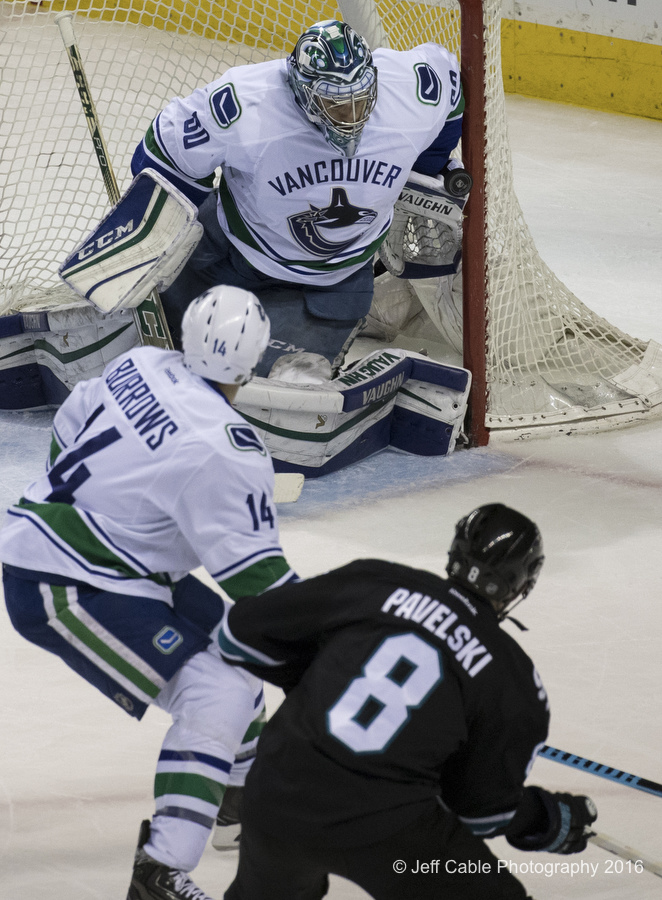
After doing all the technical tests, I took the Canon 1DX Mark II into the field to do some real world testing. I shot an entire NHL game with the camera, using the Canon 70-200mm lens (when shooting at ice level, through the hole in the plexiglass) and the Canon 100-400mm lens (when shooting from up in the stands). None of the photos were taken using strobes, and therefore required high ISO and fast shutter speeds to capture the action. My goal was to simulate my photography environment at the upcoming Olympics.

Here are photos from the shoot:


The focus tracking was very fast, and was able to track the athletes even though they were coming straight at me at a fast rate of speed.


For this photo, I had moved the focus point from the center to a higher point. It appears that the focus is more accurate at other points (not just the center point) than on the previous model.


All of the photos were taken using Auto White Balance and needed little to no adjustments when processing the images.


I liked this shot, but felt that it needed to be cropped tighter.


Here is the tighter crop.


This VERY tight crop shows you the level of detail captured by the Canon 1DX Mark II (at ISO 1600).



In total, I shot 57.3GB of photos, all in full RAW format. Using my Mac Pro desktop machine, I was able to download all the photos onto my external hard drive in 6 minutes and 20 seconds using the Lexar 3500x CFast card, Lexar CFast reader and the Lexar HR2 Hub.

CONCLUSION

After having the Canon 1DX Mark II in my hands for the last month, I can tell you that this is the next step forward in the 1 Series of cameras for Canon. It has tons of new features, including 4K video, integrated GPS, more focal points, and a ton more that you can read about in other reviews. But for me, it is about quality and speed, and this camera delivers that.

If you have read through all of this, and made it to the very end here, you have probably determined that CFast is a helpful new card format. Yes, there are some drawbacks, since most of you probably do not own these new cards yet, and they are not cheap. You may have to invest in a new set of memory cards for your collection. But they do offer other advantages over CF, other than just speed, in that there are no pins that can easily be bent.

Based on all of this testing, here is what I have determined to be the best scenario for my shooting in Rio De Janeiro. I am going to shoot to both the CFast card and CF cards, for redundancy reasons. I am willing to limit my burst shots in favor of having peace of mind knowing the images are being stored in two places. When shooting at the NHL game, there was not one time when I had to wait for the buffer to clear. I will then eject and download all of my photos from the CFast cards, leaving the high capacity CF cards in the camera as backup only.

Yikes - this has to be one of the geekiest blogs I have ever written. For those of you who are not technical, and saw this as a bunch of technical mumbo jumbo, please accept my apologies. :)

Three months from now I will be in Rio for the Summer Olympics and putting the Canon 1DX Mark II and all of this to good use!

_________________________________________________________________________________

If you are interested in purchasing any camera equipment, please click here to go to B&H Photo, as I get a referral from them if you enter this way. It does not change the cost to you in any way, but it helps me keep this blog up and running.
_________________________________________________________________________________

And also, remember that you and your friends can enter your email address at the top right of this blog to get an email any time I write a new blog post or send my monthly newsletter.


_________________________________________________________________________________

Wednesday, April 27, 2016

100 Day Countdown to the Summer Olympics in Rio!

Today marks the 100 day countdown to the Summer Olympics in Rio and the excitement is growing! I woke up this morning and thought about the last 4 Olympics that I have been lucky enough to photograph. To commemorate today, I decided to post images from opening ceremonies from each of those big days.


The 2008 Summer Olympics in Beijing was the first Olympics for me, and one that I will never forget. At that time, I was not able to get "up credentialed" to shoot the opening ceremonies, but I was able to get a premises pass that would let me shoot from outside the Bird's Nest.


Every Olympic year, there is a lot of talk about how the host city is not ready for the Games. Although I have found this to be a lot of hype, there is also some truth to it. I shot this photo of a Chinese man working on the Olympics grounds at midnight, the day before the opening ceremony.


Here is one of my favorite moments from the Beijing Olympics. Having a chance to see and photograph Michael Phelps in many of his competitions, I had a smile from my face for days.


Approximately two years later (2010), I was photographing the Winter Olympics in Vancouver. And this time, I was able to get a ticket into the Opening Ceremonies and experience that for the first time. (Even press have to be ticketed for certain "high impact" events.)  


One part of the Olympic Flame failed to rise from the floor, but I didn't care. It was still beautiful, and made for a good story.


This fish eye shot was one of my favorites from the Vancouver Olympics. I was shooting (and continue to) for USA Hockey in the Winter Games and feel honored to do so. I love watching and playing hockey, so this is very natural for me.


In 2012 I was in London to photograph the Summer Olympics. Here is photo from their Opening Ceremonies. Ever time I look at these photos, it brings back memories for me. I remember having to be in the stadium for 7 hours prior to the start of the ceremony and the many hours of anticipation leading up to the event.


I was sitting in the "head-on" photo position, which save me a clear shot of each team entering the stadium. This photo was one of my favorites from the London Opening Ceremonies, as the home team entered for the first time. I still get chills when I see this.


The Summer Olympics in 2012 was my first time shooting for USA Water Polo and it ended up being an amazing experience. I really enjoy the sport, and more importantly I love the support people at USAWP and the athletes themselves.


Photographically, it was a challenge to get unique shots for the team, but the team was very happy with the results. So much so that we are working together again in Rio.


This photo was one of my favorites from London, because it was the first time I ever photographed a Gold Medal match for "my team". I am hoping that I am in the same situation with both the men's and women's teams this year!

My favorite moment from the London Games happened hours after this photo was taken. After hours of editing and posting for the team and their advertisers, I was invited to the team party. Not as their photographer, but as a part of the team. I remember talking to many of the athletes who told me that they could not wait to get back to the village after each game to log in and see the photos that I had taken. How cool is that?


And then there were the 2014 Games in Sochi, Russia, where I was once again photographing for USA Hockey as my primary team. For these Opening Ceremonies, I was sitting in a higher position, but still able to zoom in and capture Team USA entering the stadium. Chills once again!


As many of you know, Sochi had a lot of challenges for myself and the other media. But overall, I still think of those Games with fond memories. Heck, I came home with a ton of really crazy stories to share with all of you.


This photo shows one of my favorite moments from the Sochi Olympics when T.J. Oshie was called upon to make one shootout goal after another. It isn't often that I get to see and feel the game when I am shooting, since I am concentrating on getting good photos, in focus and at the peak of action. But this game was incredibly exciting, even for me as I was doing my job.


I took this night shot of the Olympic Flame towards the end of the 2014 Winter Olympics. Being one of the last shots taken at that Olympic Games, It is the perfect transition photo to the next Games.

After years of planning, I am very excited about my upcoming trip to Rio. I am flying there 5 days before the Opening Ceremonies, so that I can shoot and share lots of behind the scenes photographs with all of you!

_________________________________________________________________________________

If you are interested in purchasing any camera equipment, please click here to go to B&H Photo, as I get a referral from them if you enter this way. It does not change the cost to you in any way, but it helps me keep this blog up and running.
_________________________________________________________________________________

And also, remember that you and your friends can enter your email address at the top right of this blog to get an email any time I write a new blog post or send my monthly newsletter.


_________________________________________________________________________________

Tuesday, April 19, 2016

A little bit of China in downtown Portland, Oregon - The Lan Su Chinese Garden

A couple of weeks ago, my wife and I flew up to Portland, Oregon to celebrate our 25th anniversary and see our daughter, who is currently studying at the University of Portland. If you read the last Portland blog post, you know that we spent a couple of days visiting the Columbia Gorge. While we were at the gorge, I took an iPhone shot of one of the waterfalls and posted it on Instagram and Facebook. (If you are not following me on Instagram and Facebook, be sure to do that, since I try to post a new photo everyday.) After posting that photo, a nice gentleman named Scott contacted me and welcomed us to his home city. He also said that he was the Director of Marketing at the Lan Su Chinese Garden, and invited my family and I to stop by.

One of the great things about having all you blog readers is that I often get a chance to meet new friends wherever I travel!

It turns out that we did indeed have a couple hours free on our last day in Portland, and so my wife, daughter, and I stopped by to meet Scott and see what this was all about. And I have to tell you, we were amazed with this beautiful garden, right in the middle of downtown Portland!

(Canon 5D Mark III, 24-105mm lens at 45mm, ISO 640, f/10, 1/640 sec, -0.3 exposure comp)
We parked close by to the garden, and walked towards the Lan Su Chinese Garden. Since the skies were overcast, I decided to leave my Tiffen HT circular polarizing filter in the car and just grab my Canon 5D Mark III and 24-105mm lens. But just a minute or two later, the skies cleared and we saw some blue through the clouds. Filter or not, I was happy to have something other than a grey sky to work with. I saw this reflection in the water and loved the mirror image effect.


At the front entrance of the garden, I looked up and saw this tiny little hummingbird perched on the dragon.


When photographing, I always look for interesting repeating patterns. When first entering the garden, we saw this amazing stone work. Scott told me that each of the large curved pieces was the same tile as used on the roof of the buildings.

(Canon 5D Mark III, 24-105mm lens at 24mm, ISO 640, f/10, 1/320 sec, -0.3 exposure comp)
This was the first room that we entered. I loved the view of the garden through the ornate windows. I stepped back and shot this through the doorway. I metered for the outside and let the doorway and windows go dark. When editing this photo, I used the lens correction filter in Adobe Photoshop to make sure that all the lines were straight.

(Canon 5D Mark III, 24-105mm lens at 75mm, ISO 500, f/4, 1/30 sec)
Here is a detail shot of the woodwork in this first room. For this photo, I metered on the wood, since this was my "subject" and I wanted it to be exposed correctly.

(Canon 5D Mark III, 24-105mm lens at 105mm, ISO 320, f/4, 1/160 sec)
Also inside this room was a Chinese man who did these amazing paintings. My wife and daughter purchased a hand-painted piece with our last name.


It was fascinating to watch this talented artist work his magic with the simplest of tools. I got down low and took tight shots showing the details of his artistry.


I look at people like this, who can create art without a camera (like my wife) and think "wow - these people are truly talented!"


The painting almost completed.


After getting our painting and leaving that building, we entered the garden. Looking back, I took this photo, not because it was a good scenic shot, but to show you how the garden is placed right in the middle the office buildings in downtown Portland.

(Canon 5D Mark III, 24-105mm lens at 60mm, ISO 160, f/4, 1/100 sec, -0.3 exposure comp)
Here is an ornately carved wood wall.


After walking through this circular entry, I turned around and shot this off-center.


I really liked the view from this location at the far end of the garden. There were a lot of people walking around, but I waited for all them to move on before grabbing this shot.

(Canon 5D Mark III, 24-105mm lens at 28mm, ISO 640, f/10, 1/640 sec, -0.3 exposure comp)
This is my favorite photo from the Lan Su Chinese Garden. I love the colors, the reflection, the bright blue sky, and the puffy clouds. I purposely stood in a spot where I did not see any of the office buildings in the background. All you see in the photo is the Chinese architecture and foliage. I have showed this photo to many friends and asked them where they think I took this. Every one of them thought this was taken in China.

To learn more about Lan Su Chinese Garden, check out their web site. And I would like to thank Scott Steele for the invitation and the hospitality!

_________________________________________________________________________________

If you are interested in purchasing any camera equipment, please click here to go to B&H Photo, as I get a referral from them if you enter this way. It does not change the cost to you in any way, but it helps me keep this blog up and running.
_________________________________________________________________________________

And also, remember that you and your friends can enter your email address at the top right of this blog to get an email any time I write a new blog post or send my monthly newsletter.


_________________________________________________________________________________


Monday, April 11, 2016

Wow! Something different and amazing!

About 20 minutes ago, I was sitting at my desk and finishing another blog post for all of you, when I got a text message from my daughter, Ali. The message was just a url, and I had no idea what the heck she was sending me. I clicked the link and what I saw and heard blew me away! So much so, that I am putting my other blog post on hold and sharing this with you all.

Here is the video:


This is my daughter giving her speech today at University of Portland. Ali has Crohn's Disease, which is an invisible disease which affects her stomach and digestive system. She has had numerous instances where she has used a handicap pass on her car. Because people see her walking from the car without any obvious signs of what we all consider "handicap", they pass judgement. I am not going to say any more, I invite you to be inspired by daughter.

You can click the video image above or click here to be inspired yourself.

Enjoy,

One proud father...